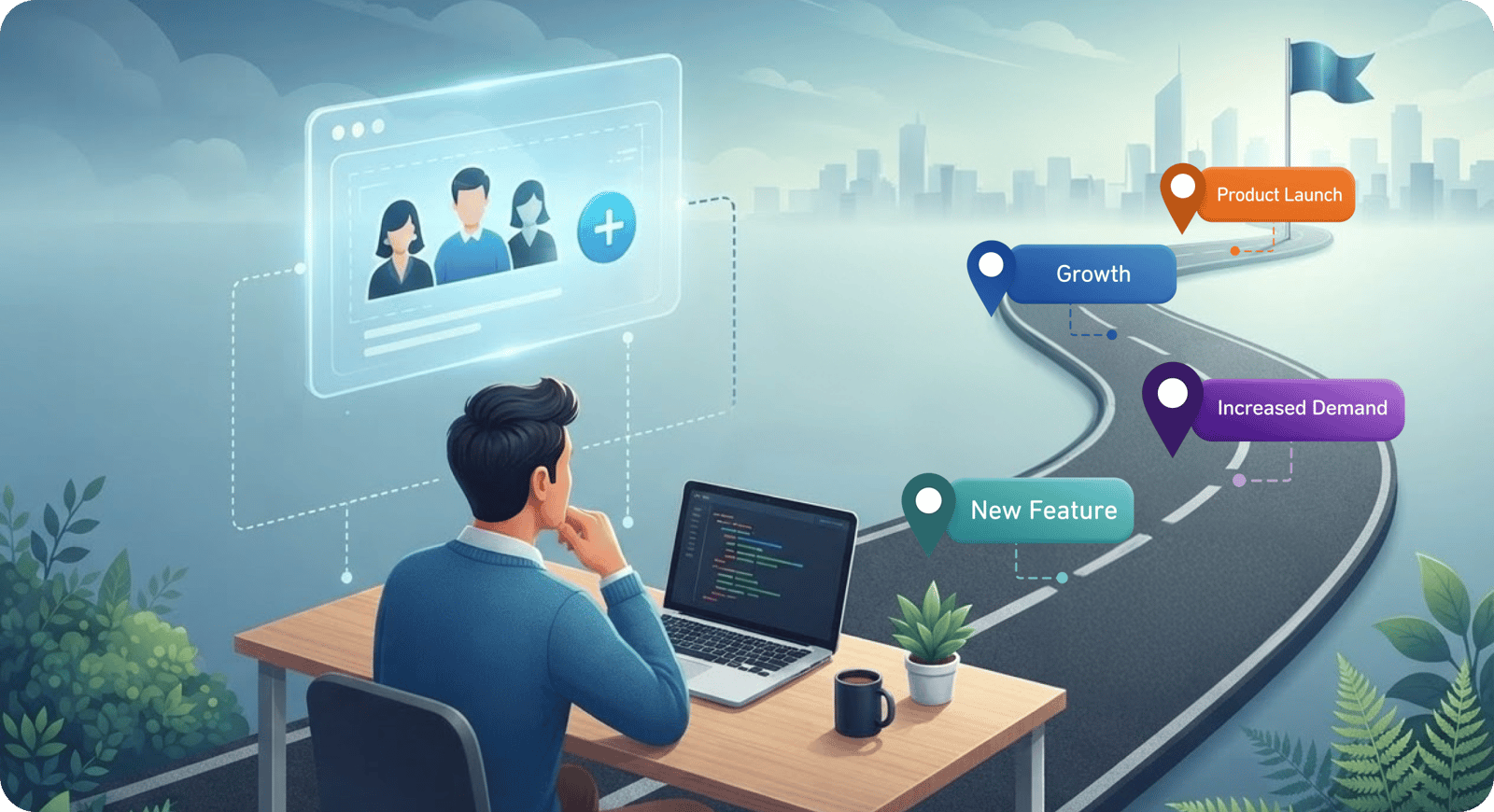
But hiring takes time. You have to find the right people, go through the hiring process, onboard them, and give them time to understand the product and the way your team works.
The roadmap, meanwhile, keeps moving.
And when the additional workload is tied to a specific project, product launch, or period of increased demand, adding permanent employees may not always be the most practical option.
It starts with understanding what the work actually requires.
Start With the Work, Not the Headcount
Before opening new positions, look at where the pressure is coming from.
Do you need more development capacity?
Is there a technical skill your current team doesn't have?
Does the project need additional QA or DevOps support?
Is your existing team already busy with the core product?
These questions help clarify what kind of support the project actually needs. Then there's another question that can shape the decision:
Will you need these capabilities long term?
If the business expects to need the same skills and engineering capacity as part of its ongoing operations, permanent hiring may make sense.
But if the need is tied to a specific project, product launch, or period of increased demand, a dedicated engineering team can provide the additional skills and capacity needed without expanding the permanent team structure.
The issue isn't always a lack of engineers. Sometimes, the existing team simply doesn't have the right combination of skills or capacity to take on the next piece of work.
Consider a Real-World Scenario
Imagine a growing software company preparing to launch a major new product feature.
Its existing engineering team is already working on the core product, handling customer requests, fixing issues, and maintaining the current platform.
Now the new feature comes along. It needs development support, but it also needs QA, DevOps expertise, and someone to keep the work moving across the different parts of the project.
One option is to hire several permanent employees.
But if the immediate goal is to deliver a specific initiative over the next few months, permanent hiring may not be the only option.
A dedicated team can bring together the capabilities needed for that specific initiative while allowing the internal team to remain focused on the core product.
A real example of this approach can be seen in Axceera's work with IML Delivery Systems (Pvt) Ltd (CityPak) to enhance its courier management system.
As Aminda Keerthiratne, Head of Digital Transformation at IML Delivery Systems (Pvt) Ltd, explains:
Axceera has been pivotal in enhancing our courier management system at IML Delivery Systems. They worked closely with us to extend customer-centric and operational modules, improving the user experience for both internal and external customers. Axceera's expertise enabled us to adopt a quick and cost-effective approach, ensuring that these features were delivered to our customers promptly.
This example highlights an important point: scaling engineering capacity doesn't always mean building a larger permanent team. Sometimes, the better fit is bringing together the right skills and delivery capacity around a specific business need.
What Does a Dedicated Team Actually Look Like?
A dedicated team isn't simply a group of extra developers added to an existing team.
It is built around the work that needs to be done.
For example, a three-month product initiative might require:
2 Software Engineers + 1 QA Engineer + 1 Project/Delivery Manager
with DevOps support added when required.
That team could look different a few months later, depending on the project stage and what needs to be delivered next.
That gives companies more room to respond to changing priorities instead of committing to a fixed team structure from the beginning.
When Does This Make Sense?
There's no single approach that works for every company.
A dedicated team may be worth considering when a company:
Is starting a new product or major initiative
Needs expertise that isn't available internally
Has more delivery work than its current team can take on
Wants a focused team for a specific project
Needs additional capacity without expanding its permanent team structure
The goal isn't to build the biggest engineering team.
It's to have the right capacity and capabilities for the work ahead — whether that means hiring permanently or bringing in a dedicated team for a specific period.
What Does the Business Gain?
A dedicated engineering team can provide practical benefits when a business needs to move a specific initiative forward without changing its permanent team structure.
For example, it can help businesses:
Move faster
Start important work without waiting for a full internal hiring cycle. As IML's experience demonstrates, having the right expertise in place can help get new features to customers more promptly.
Keep existing teams focused
Your internal engineers can stay focused on the core product instead of having to divide their attention across every new initiative.
Add the skills you actually need
Need QA, DevOps, or a particular development skill for a project? You can add those capabilities when they are needed without turning every requirement into a permanent hire.
Stay flexible
Increase or adjust engineering capacity as the project develops and priorities change.
The result is not simply a larger engineering team. It is a team structure that can adapt to what the business needs to deliver — while keeping the focus on customer outcomes, delivery speed, and the product roadmap.
Build Around What Your Roadmap Requires
This is where Axceera's Dedicated Engineering Teams model can help.
Rather than simply adding people to an existing team, Axceera helps businesses build engineering teams around the work they need to deliver.
That could mean adding development capacity for a new product, bringing in specific technical expertise, supporting a major feature, or creating a dedicated team for a larger initiative.
The team should fit the roadmap — not the other way around.
Your roadmap shouldn't have to wait for your hiring timeline.